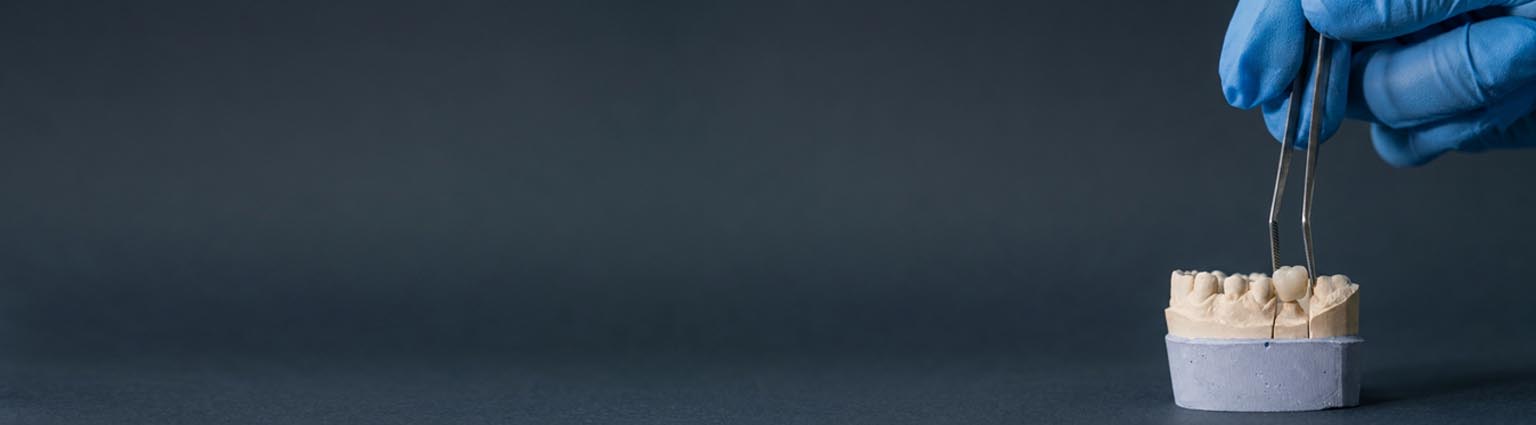
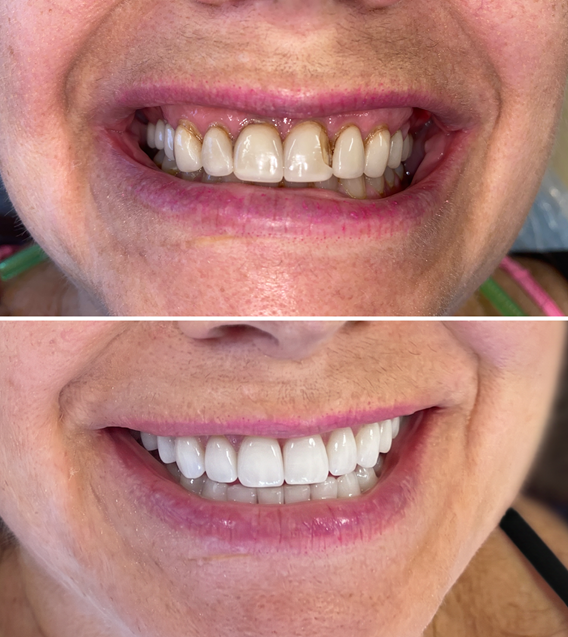
Ceramic dental crowns are tooth-colored restorations designed to protect a damaged or weakened tooth while restoring its natural shape, strength, and appearance. Treatment typically requires two dental appointments, and with proper care, a well-designed ceramic crown can last 10 to 15 years—sometimes longer.
The material matters. But so does everything around it.
A crown must protect the tooth beneath it, fit precisely at the gumline, withstand the patient’s bite, and appear at home beside the surrounding teeth. A front tooth with a visible fracture presents a different challenge from a heavily restored molar. A patient who grinds their teeth may require a different ceramic and bite design from someone restoring a single tooth in the smile line.
At San Diego Integrative & Implant Dentistry, ceramic crowns are planned around the individual tooth rather than selected as a standardized product. The amount of healthy structure remaining, the tooth’s location, the color beneath the restoration, the surrounding gum tissue, and the forces placed on the crown all influence the final design.
The visible restoration is only one part of the treatment architecture.
A dental crown is a custom-made cap that covers the visible portion of a natural tooth. It may be recommended when a tooth has lost too much structure to be restored predictably with a filling alone.
The crown restores the tooth’s:
Ceramic dental crowns are made without a metal substructure. Their tooth-colored composition allows the dentist and dental laboratory to reproduce the color, translucency, surface texture, and reflective qualities of natural enamel.
This makes ceramic crowns one of the most natural-looking restorative options available for both front and back teeth.
A ceramic crown may be appropriate when a tooth requires more protection or structural support than a filling can provide.
Common reasons include:
Not every damaged tooth requires a full crown. When enough healthy structure remains, a ceramic onlay or partial-coverage restoration may sometimes preserve more of the natural tooth.
Conservative dentistry is not simply doing less. It is preserving what is valuable while providing enough protection for the tooth to function predictably.
Ceramic crowns offer a combination of esthetics, strength, and material-conscious restorative planning.
Natural teeth are not a single flat shade of white. Enamel reflects and transmits light in subtle ways, creating depth, translucency, and variation across the tooth.
A carefully designed ceramic crown can reproduce these optical qualities more convincingly than an opaque metal-based restoration. The result can blend closely with the surrounding teeth rather than appearing like a separate dental material.
This is particularly important for front teeth, where small differences in brightness, shape, texture, and translucency are immediately visible.
An all-ceramic crown contains no metal substructure. This eliminates the dark metal line that can sometimes become visible at the gumline around a porcelain-fused-to-metal crown, particularly if the gum tissue recedes.
Ceramic crowns may also appeal to patients who prefer metal-free restorative materials or have a documented sensitivity to components used in certain dental alloys.
The crown itself is metal-free. However, a previously treated tooth may still contain another component beneath it, such as a metal post. For patients prioritizing material composition, the complete restorative foundation should be reviewed—not only the visible crown.
Modern dental ceramics have expanded the situations in which all-ceramic crowns can be used.
Stronger ceramics can withstand substantial chewing forces in the posterior mouth, while more translucent materials can provide nuanced esthetics for visible teeth. The appropriate material depends on the tooth, the bite, the available ceramic thickness, and the patient’s functional needs.
The strongest material is not automatically the best one.
The right material is the one that provides the necessary strength without sacrificing fit, esthetics, or healthy tooth structure.
“Ceramic” describes a family of materials rather than one universal crown.
Two of the most commonly discussed options are zirconia and lithium disilicate.
Zirconia is known for its strength and resistance to fracture. It is frequently selected for molars, patients with heavier bite forces, and teeth that require substantial structural protection.
Modern zirconia is available in different levels of strength and translucency. Some formulations prioritize durability, while others are designed to provide a more natural appearance in visible areas.
Zirconia may be particularly useful when:
Lithium disilicate is a glass-ceramic valued for its balance of strength, translucency, and esthetic control. Many patients recognize it through the brand name e.max.
Because it interacts with light in a way that can closely resemble natural enamel, lithium disilicate is often considered for front teeth, premolars, and restorations in highly visible areas.
It may be selected when:
Neither zirconia nor lithium disilicate is universally superior. Material selection should follow the clinical problem, not the popularity of a brand name.
The ceramic itself provides the potential for a natural result. The planning and execution determine whether that potential is realized.
A convincing crown depends on the coordination of several details:
A crown can be white and still look artificial.
The objective is not simply to create a brighter tooth. It is to create a restoration that belongs within the patient’s face, smile, and natural dentition.
At San Diego Integrative & Implant Dentistry, ceramic crown treatment is completed over two appointments.
The first visit begins with a detailed evaluation of the tooth, surrounding gum tissue, bite, and existing restoration or decay.
The area is numbed with local anesthetic. The dentist then removes damaged, decayed, or unsupported tooth structure and shapes the tooth to create the space required for the ceramic crown.
If a substantial portion of the tooth is missing, a core buildup may be placed to provide an appropriate foundation.
A digital scan or traditional impression is then taken to record:
This information is sent to a dental laboratory, where the ceramic crown is individually fabricated. Shade information, photographs, surface characteristics, and other esthetic instructions may also be communicated to the ceramist.
A temporary crown is placed over the prepared tooth to protect it while the definitive restoration is being made.
The permanent crown is generally returned from the laboratory within approximately one to two weeks.
At the second visit, the temporary crown is removed and the definitive ceramic crown is evaluated carefully.
The dentist assesses:
Only after these details have been reviewed is the crown permanently bonded or cemented into place.
The entire process is generally straightforward, and most patients can return to their normal routine the same day.
With proper care, ceramic dental crowns typically last 10 to 15 years. Some remain functional considerably longer.
Their lifespan depends on more than the ceramic alone.
Important factors include:
Zirconia crowns are frequently chosen for their exceptional strength, particularly in areas exposed to substantial pressure. Lithium disilicate also performs well when selected for the appropriate tooth and clinical conditions.
No material can compensate for an unstable foundation or an uncontrolled bite.
Longevity begins before the final crown is placed.
A ceramic crown should be maintained much like a natural tooth.
Patients should:
The ceramic itself cannot develop decay, but the natural tooth beneath it can. Keeping the crown margin clean is therefore essential to its long-term success.
Ceramic crowns are also highly resistant to staining, but they do not respond to whitening treatments. When a patient plans to whiten their natural teeth, whitening is generally completed before the crown shade is selected.
An all-ceramic dental crown generally costs between $1,000 and $1,800 per tooth.
The final cost depends on several factors, including:
Many dental insurance plans provide partial coverage when a crown is considered medically necessary. Cosmetic changes alone may not receive the same level of coverage.
A clinical evaluation allows the practice to determine the appropriate treatment and provide a personalized estimate before care begins.
Ceramic crowns are an excellent option for many patients, particularly those seeking a restoration that combines natural appearance, structural protection, and the absence of a metal framework.
The best choice depends on:
At San Diego Integrative & Implant Dentistry, the objective is not merely to cover a damaged tooth. It is to preserve what remains, restore function, and design a ceramic restoration that feels visually and structurally appropriate for the individual patient.
Patients from San Diego County, Orange County, Los Angeles, and surrounding Southern California communities may begin with a comprehensive restorative evaluation.
To schedule a consultation, contact San Diego Integrative & Implant Dentistry at (858) 683-4862.
The procedure itself should not be painful because local anesthetic is used before the tooth is prepared. Some patients experience mild sensitivity or gum soreness after the appointment, but this generally improves within several days.
The terms are sometimes used interchangeably, but ceramic is the broader category. It includes zirconia, lithium disilicate, and traditional dental porcelains. A porcelain-fused-to-metal crown contains a metal framework and is therefore not an all-ceramic restoration.
Neither is better for every patient or every tooth. Zirconia is frequently selected for strength and higher-force areas, while e.max lithium disilicate is valued for its translucency and esthetic versatility. The right material depends on the tooth’s location, underlying color, available space, and bite forces.
Yes. Modern zirconia and selected lithium-disilicate crowns can be used on back teeth when the preparation, thickness, bite, and material are appropriately planned.
No. Ceramic crowns do not respond to whitening products. Patients considering professional whitening should generally complete it before the final crown shade is selected.
Most patients can eat once the anesthetic has completely worn off. It is sensible to avoid very hard or sticky foods during the first 24 hours while the crown and surrounding tissues settle.