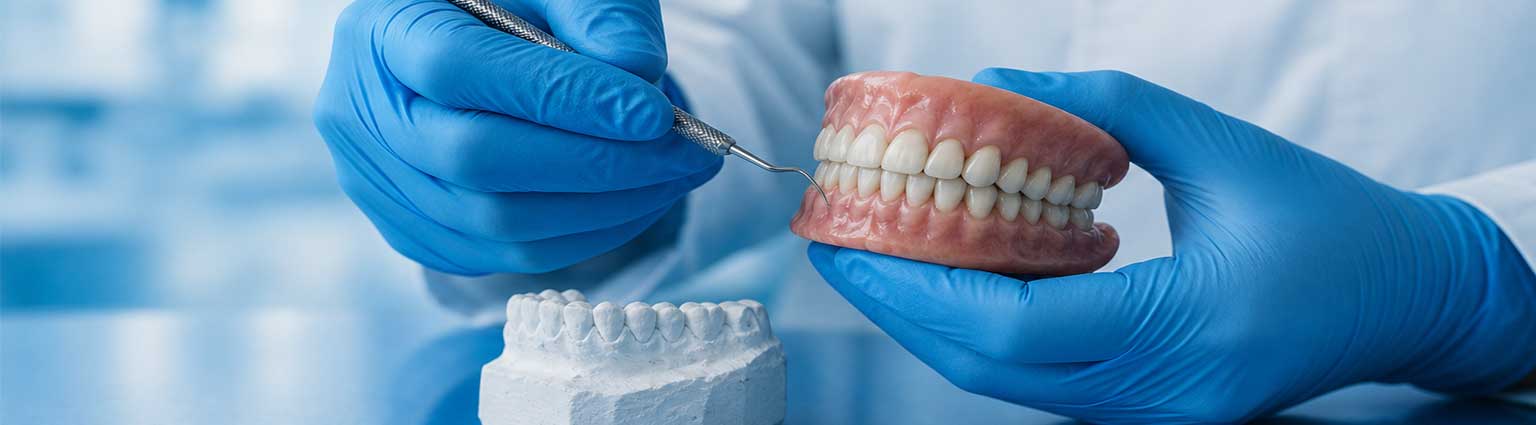
Missing teeth can affect far more than the appearance of the smile. They may change how you chew, speak, support the lips and cheeks, and feel during everyday conversations and meals.
Full and partial dentures are removable restorations designed to replace missing teeth and restore function, facial support, and confidence. A complete denture replaces all teeth in one arch, while a partial denture replaces selected missing teeth and works with the natural teeth that remain.
At San Diego Integrative & Implant Dentistry, dentures are designed around the individual—not selected from a standard mold. We consider your anatomy, remaining teeth, gum and bone contours, bite, facial features, speech, dexterity, material preferences, and long-term goals before recommending a design.
Our team also explains how traditional dentures compare with implant overdentures, fixed implant-supported teeth, dental bridges, and other replacement options so you can make an informed decision.
What Is a Denture?
A denture is a removable dental prosthesis used to replace missing teeth and surrounding oral structures.
A denture may replace:
Dentures are designed to restore the visible teeth while also accounting for the soft tissues, jaw ridge, bite, speech, and facial support.
Although dentures are removable, their design requires careful restorative planning. Tooth position, tooth shape, material, bite, flange contours, and the relationship with the lips, cheeks, and tongue all influence how the final result looks and functions.
What Is a Complete Denture?
A complete denture, also called a full denture, replaces all natural teeth in the upper or lower arch.
Complete dentures may be used when:
An upper denture typically gains support from the palate and gum-bearing tissues.
A lower denture rests on a smaller ridge and must function within the movement of the tongue, lips, and cheeks. Lower dentures may therefore be more challenging to stabilize, particularly when significant bone loss has occurred.
Dental implants may be considered when additional retention and stability are needed.
What Is a Partial Denture?
A removable partial denture replaces some—but not all—teeth in an arch.
It may use the remaining natural teeth, gums, and supporting ridge for stability.
A partial denture may be appropriate when:
A partial denture helps fill the spaces created by missing teeth while supporting chewing, speech, smile continuity, and tooth position.
The health of the remaining teeth is especially important because they may serve as anchors, guides, or supports for the prosthesis.
Complete Dentures and Partial Dentures: The Main Difference
The main distinction is the number of teeth being replaced.
Complete Denture
A complete denture replaces every tooth in the upper or lower arch.
Partial Denture
A partial denture replaces selected missing teeth while working around the natural teeth that remain.
Partial dentures require careful evaluation of:
If supporting teeth are weak, decayed, mobile, or affected by periodontal disease, they may require treatment before the partial denture is made.
Conventional Complete Dentures
A conventional complete denture is generally fabricated after teeth have been removed and the tissues have had time to heal.
Allowing the tissues to heal before final fabrication may provide a more stable foundation because the gums and bone undergo significant change after extractions.
A conventional denture process may include:
The patient may be without teeth during part of the healing period unless a temporary or immediate denture is provided.
Immediate Dentures
An immediate denture is prepared before the remaining teeth are removed and inserted shortly after extraction.
This allows the patient to leave with teeth rather than remaining without a visible smile during early healing.
Immediate dentures may provide:
However, the gums and jawbone change rapidly after extractions. As swelling decreases and the ridge heals, an immediate denture may loosen or require adjustment.
Patients may need:
An immediate denture should therefore be understood as part of a staged treatment process rather than as a final restoration guaranteed to maintain its original fit.
Partial Denture Designs
Partial dentures can be made in several designs.
Acrylic Partial Dentures
An acrylic partial denture generally uses a pink acrylic base with replacement teeth and wire or other retentive components.
It may be used as:
Acrylic partials may be bulkier than framework designs and may not provide the same degree of stability in every case.
Cast-Metal Framework Partial Dentures
A cast-metal partial denture uses a precisely designed framework beneath the acrylic and replacement teeth.
Potential advantages may include:
Visible clasps or metal components may be present depending on the design.
Flexible Partial Dentures
Flexible materials may provide an alternative appearance and may avoid some visible metal clasps.
However, flexible partials are not ideal for every situation. They may be more difficult to adjust, reline, repair, or support predictably in certain cases.
Material flexibility should not be confused automatically with superior comfort or function.
Implant-Assisted Partial Dentures
Dental implants may sometimes be used to improve the support, retention, or stability of a removable partial denture.
This can reduce movement in areas where natural tooth support is limited.
The implant position and partial-denture design must be planned together.
Who May Benefit From Dentures?
Dentures may be considered for patients who:
Candidacy depends on the condition of the teeth, gums, jawbone, muscles, medical history, dexterity, expectations, and ability to maintain the prosthesis.
When Another Tooth-Replacement Option May Be Preferable
Dentures are not the only way to replace missing teeth.
Depending on the clinical situation, alternatives may include:
A fixed option may appeal to patients who do not want to remove their teeth at night or who want greater stability during chewing.
A removable option may provide easier access for cleaning, support facial contours, or fit a patient’s anatomy, health, preferences, or financial priorities more appropriately.
The right choice is based on more than convenience alone.
The Role of the Prosthodontist
A prosthodontist is a dental specialist with advanced training in restoring and replacing missing teeth.
Prosthodontic expertise may be especially valuable when a patient has:
At San Diego Integrative & Implant Dentistry, the prosthodontist works with the general dentist, periodontist, oral and maxillofacial surgeon, and dental laboratory when a case requires multidisciplinary planning.
Your Denture Evaluation
A comprehensive evaluation may include:
Dental X-rays or three-dimensional imaging may be recommended when teeth, roots, bone, pathology, extractions, or implant treatment require further evaluation.
Planning Tooth Position and Facial Support
Denture teeth should not be positioned according to a generic template.
Their position affects:
When teeth have been missing for a long time, the jaw ridge may have changed significantly.
The denture may need to replace both the missing teeth and some of the lost tissue volume. The design must balance support with comfort and avoid creating an appearance that feels overly full, flat, or unnatural.
Selecting Tooth Shape and Shade
Denture teeth are selected according to factors such as:
The goal is not automatically to create the whitest or most symmetrical possible smile.
A refined result should feel harmonious with the individual and should preserve natural character when that is desired.
The Denture Fabrication Process
We evaluate the teeth, gums, bone, bite, current prosthesis, and treatment options.
Initial impressions or digital scans may be taken to study the anatomy and plan the next stage.
Detailed impressions record the tissues that will support the denture.
The technique is selected according to the anatomy, tissue condition, and prosthetic design.
Measurements are taken to establish:
Tooth shape, size, shade, and arrangement are selected.
The proposed teeth may be arranged in wax so the patient and clinical team can evaluate:
Changes can be made before the final denture is processed.
The dental laboratory processes the definitive denture according to the approved design.
At delivery, we evaluate:
New dentures commonly require adjustments as the tissues and muscles adapt.
A sore area does not necessarily mean the entire denture is incorrect. Small pressure points can often be identified and relieved.
Learning to Eat With New Dentures
Eating with dentures is a learned skill.
During the adaptation period:
Complete dentures do not reproduce the exact sensory feedback or chewing efficiency of natural teeth.
Implant support may improve stability and function for selected patients, especially in the lower arch.
Speaking With New Dentures
Dentures alter the space available to the tongue and change the contours against which speech sounds are formed.
Temporary changes may occur with sounds involving:
Practice may include:
Most patients adapt with time, but persistent concerns should be evaluated.
Denture Retention and Stability
Retention describes how well the denture resists being pulled away from the tissues.
Stability describes how well it resists rocking or sliding during function.
Fit may be influenced by:
Upper complete dentures often benefit from a broader supporting surface and palatal seal.
Lower complete dentures have less supporting area and are influenced more strongly by tongue and floor-of-mouth movement.
Patients with a severely resorbed lower ridge may benefit from discussing implant overdenture treatment.
Denture Adhesives
Denture adhesive may improve confidence or retention in selected situations.
It may be useful when:
Adhesive should not be used to compensate indefinitely for a denture that is significantly loose, damaged, painful, or no longer fits.
Repeated heavy adhesive use may signal that the denture requires:
Use only the amount and product recommended, and remove adhesive completely during daily cleaning.
Denture Relines, Rebases, and Replacement
The jawbone and gums continue to change after teeth are lost.
Over time, a denture may lose retention, support, or stability even if it originally fit well.
Reline
A reline adds material to the tissue-facing surface of the denture to improve adaptation to the current ridge.
Rebase
A rebase replaces most of the denture base while retaining the existing denture teeth when appropriate.
Replacement
A new denture may be needed when:
Dentures are medical devices with limited lifespans. They should be evaluated regularly rather than assumed to remain unchanged indefinitely.
Denture Repairs
Contact the office if a denture:
Do not attempt to repair a denture with household glue.
Some adhesives contain substances unsuitable for the mouth and may distort the pieces, making professional repair more difficult.
Cleaning Full and Partial Dentures
Dentures should be cleaned every day.
General care may include:
Avoid:
Some denture materials must remain moist when not being worn to avoid warping.
Should Dentures Be Removed at Night?
Patients are generally advised to remove removable dentures for a period each day, often during sleep, unless given different instructions for a specific clinical reason.
This gives the supporting tissues time without continuous pressure and allows the prosthesis and mouth to be cleaned thoroughly.
Sleeping in dentures may increase plaque accumulation, tissue irritation, and fungal inflammation in susceptible patients.
Immediate dentures may follow different instructions during the first stage after extraction. Follow the surgeon’s or dentist’s specific postoperative guidance.
Caring for the Mouth When All Teeth Are Missing
Patients without natural teeth still require dental care.
Daily oral care may include:
Regular examinations allow the clinician to assess:
The absence of teeth does not eliminate the need for oral-health evaluation.
Caring for Remaining Teeth With a Partial Denture
A partial denture places additional importance on the health of the remaining teeth.
Plaque may collect around:
Home care may include:
If a supporting tooth is lost, the partial denture may require modification or replacement.
Dentures and Dry Mouth
Saliva helps lubricate oral tissues and may contribute to denture comfort and retention.
Dry mouth may be associated with:
Dry mouth may contribute to:
Management begins with identifying possible causes and may include hydration, saliva-support products, medical coordination, fluoride, and modification of the prosthesis when appropriate.
Dentures and the Gag Reflex
Some patients have difficulty tolerating a denture because of gagging or a sense of bulk.
Contributing factors may include:
Treatment may involve adjustment, desensitization, breathing strategies, anxiety support, or redesign of the prosthesis.
The denture should not simply be shortened without evaluating whether that change will compromise its seal, retention, or support.
Implant Overdentures
An implant overdenture is a removable denture that attaches to dental implants.
Implants may improve:
The denture remains removable for cleaning.
Attachment designs may include:
Attachment components can wear and may require periodic replacement.
Fixed Full-Arch Implant Teeth
Fixed full-arch restorations remain attached to the implants and are generally removed only by the dental team when clinically necessary.
Compared with a removable overdenture, fixed teeth may provide:
They also require careful daily cleaning beneath the prosthesis and may involve more extensive surgery, grafting, implant placement, and financial commitment.
A traditional denture, implant overdenture, and fixed full-arch restoration are three distinct treatment pathways. We explain the differences clearly rather than presenting one option as automatically appropriate for everyone.
An Integrative Approach to Denture Care
Conventional prosthodontic principles remain the foundation of denture treatment.
Our integrative approach also considers:
Care may involve coordination with:
The purpose is to create a prosthesis that fits within the patient’s complete health, functional, and personal context.
Material-Conscious Denture Design
Dentures may include:
Material selection may consider:
A metal-free preference does not automatically make a flexible or all-acrylic design the most appropriate option.
We explain the materials present, their purpose, and available alternatives when clinically appropriate.
Frequently Asked Questions
What is the difference between a full denture and a partial denture?
A full denture replaces all teeth in one arch. A partial denture replaces selected missing teeth while working around the natural teeth that remain.
What is an immediate denture?
An immediate denture is made before the remaining teeth are extracted and inserted shortly after removal. It usually requires adjustment or relining as the tissues heal.
Will dentures look natural?
They can be designed around your facial features, tooth proportions, shade preferences, smile line, and lip support. The result should complement the individual rather than look standardized.
Will dentures restore normal chewing?
Dentures can improve chewing compared with having missing teeth, but they do not reproduce the exact efficiency or sensory feedback of natural teeth. Implant support may improve stability in selected cases.
Why does my lower denture move?
The lower jaw has a smaller supporting surface and is affected by movement of the tongue, lips, cheeks, and floor of the mouth. Bone loss may further reduce stability.
Can dental implants make my denture more stable?
Yes. Implants may be used to retain a removable overdenture or support fixed full-arch teeth.
Do I need to remove my dentures at night?
Patients are generally advised to remove removable dentures for a period each day, often overnight, unless given different instructions during immediate postoperative healing.
Can I sleep in my immediate dentures after extractions?
You may be instructed to keep an immediate denture in place initially to support the surgical area. Follow the specific instructions provided after surgery rather than routine denture guidance.
How should I clean dentures?
Rinse and brush them daily with appropriate products, clean your mouth and remaining teeth, and avoid abrasive toothpaste or hot water.
Can I use regular toothpaste on dentures?
Regular toothpaste may be too abrasive for many denture materials. Use a product and brush appropriate for dentures.
Can dentures be repaired?
Many fractures, missing teeth, or damaged components can be repaired. Bring all pieces to the office and do not use household glue.
Why has my denture become loose?
The gums and jawbone change over time. The denture may need adjustment, relining, rebasing, or replacement.
How often should dentures be replaced?
There is no single interval that applies to every patient. Dentures should be evaluated regularly and considered for replacement when fit, stability, support, function, tissue health, or materials have deteriorated.
Do partial dentures damage natural teeth?
A properly designed and maintained partial denture can function successfully, but supporting teeth remain vulnerable to plaque, decay, gum disease, and excessive force. Daily hygiene and professional care are essential.
Can I get dentures if I have gum disease?
The active disease and prognosis of the remaining teeth must be evaluated first. Some teeth may be preserved, while others may require treatment or removal before the denture is made.
Can I have a partial denture and dental implants?
Yes. Implants may sometimes improve the support or retention of a partial denture, or another implant-supported option may be recommended.
Will dentures affect my speech?
Temporary speech changes are common during adaptation. Most patients improve with practice, but persistent concerns may require adjustment.
Do I still need dental examinations if I have no teeth?
Yes. The oral tissues, denture fit, jaw ridge, and any implants still require continued professional evaluation.
Begin With a Denture Consultation
A denture should do more than fill an empty space. It should restore the relationship between the teeth, gums, bite, lips, cheeks, speech, and facial expression.
At San Diego Integrative & Implant Dentistry, our general dentist, prosthodontist, periodontist, and oral and maxillofacial surgeon can coordinate care when dentures involve extractions, gum or bone treatment, implant support, or complex rehabilitation.
Whether you need a partial denture, complete denture, immediate denture, implant overdenture, or evaluation of an existing prosthesis, we begin by understanding your anatomy, health, comfort, preferences, and goals.