
Dental materials influence more than the appearance of a restoration. They affect strength, longevity, function, tissue response, maintenance, repairability, and how treatment aligns with the patient’s preferences and long-term goals.
At San Diego Integrative & Implant Dentistry, material-conscious care means selecting every material with purpose. We consider the location of the tooth, bite forces, remaining tooth structure, surrounding gums and bone, aesthetic expectations, health history, documented allergies, material preferences, and the demands the restoration will face over time.
Our material options include BPA-free tooth-colored composite fillings, zirconia ceramic and titanium dental implants, porcelain and zirconia restorations, individualized veneer materials, and carefully selected regenerative and grafting products.
No single material is ideal for every tooth, procedure, or patient. Our role is to explain the clinically appropriate options, clarify their differences, and help you make an informed decision based on both your dental needs and personal priorities.
Material-conscious dentistry is an approach to care that gives deliberate attention to the composition, clinical purpose, performance, and long-term implications of the materials used in treatment.
It may involve decisions about:
Material selection is considered alongside diagnosis, function, anatomy, healing, appearance, and the complete treatment plan.
A material may perform beautifully in one situation and be less suitable in another.
For example:
The most responsible recommendation is based on the clinical situation and the individual patient—not on a universal material hierarchy.
Biocompatibility describes whether a material produces an appropriate response when used for a particular purpose in a particular part of the body.
A material’s performance may be influenced by:
At San Diego Integrative & Implant Dentistry, we consider the intended use, established clinical performance, available product information, and individual patient factors when selecting a material.
We do not reduce materials to simplistic categories such as universally good, bad, natural, or toxic. We evaluate what is appropriate for the specific treatment and explain the reasoning behind the recommendation.
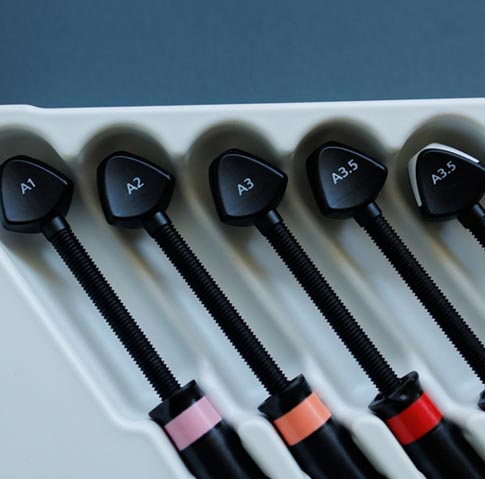
For patients who pay close attention to the materials used in their dental care, we offer BPA-free tooth-colored composite fillings as part of our material-conscious approach.
These materials allow us to restore damaged teeth while preserving healthy tooth structure and creating a result that blends naturally with the surrounding enamel.
Our BPA-free composite materials are selected for their ability to:
BPA-free composite fillings may be used to:
The exact composite is selected according to the tooth, restoration size, location, bite forces, aesthetic requirements, moisture control, and long-term functional needs.
BPA-free composite fillings combine a tooth-colored resin matrix with reinforcing glass, ceramic, or silica-based filler particles.
The restorative system may also include components that allow the material to:
Different BPA-free composite materials have different handling characteristics, strength, translucency, wear resistance, and intended uses.
A composite designed for a highly visible front tooth may prioritize polish and optical detail. A posterior composite may place greater emphasis on strength, wear resistance, and function.
Patients are welcome to ask which restorative material is being recommended. We can explain the product, its clinical role, and why it has been selected for that particular tooth.
A BPA-free composite filling may be appropriate when:
A direct filling may not provide enough support when:
In those situations, an inlay, onlay, or crown may provide stronger and more predictable protection.
The goal is not to place a filling simply because it is the smallest restoration. The goal is to select the most conservative treatment that can still protect the tooth effectively.
Most contemporary dental implant systems are made from titanium or zirconia ceramic. Both are established implant-material options, but they differ in design, restorative flexibility, appearance, clinical history, and patient preference.
Zirconia ceramic implants provide a metal-free, tooth-colored option for replacing missing teeth.
They may be particularly compelling for patients who prioritize:
San Diego Integrative & Implant Dentistry offers one-piece zirconia ceramic implant systems, including CeraRoot. Our experience includes single-tooth, multi-tooth, full-arch, and full-mouth rehabilitation.
Zirconia ceramic implants require precise surgical and restorative planning. Their position, available bone, surrounding soft tissue, bite forces, restorative space, and final restoration must all be considered together.
Titanium implants have an extensive clinical history and are available in a broad range of dimensions, designs, and restorative configurations.
They may be selected when the treatment plan benefits from:
Neither implant material is selected through ideology alone. We evaluate which option best supports the patient’s anatomy, restorative needs, aesthetic goals, material preferences, and long-term maintenance.
Composite resin is used for more than traditional fillings.
BPA-free composite may also be used to:
Its advantages may include:
Its long-term performance depends on:
When the damaged area is too extensive for a direct restoration to provide adequate support, an indirect restoration may be recommended instead.
Dental ceramics are used for veneers, crowns, bridges, inlays, onlays, and implant-supported restorations.
Different ceramics have different properties. Material selection may depend on:
Porcelain and glass-ceramic materials may offer lifelike translucency and detailed shade characterization.
They are often selected for highly visible restorations where natural light reflection and facial harmony are priorities.
Zirconia is a high-strength dental ceramic used for crowns, bridges, implant restorations, and selected veneer applications.
Different zirconia formulations vary in strength, translucency, and intended use. More translucent zirconia may be considered for selected aesthetic applications, while other zirconia designs may be preferred when strength and masking ability are greater priorities.
Zirconia is not automatically better than porcelain. The appropriate ceramic depends on the tooth, preparation, bite, desired appearance, and clinical demands.
Veneers may be made from porcelain, zirconia, or BPA-free composite resin.
“Prepless” describes how the tooth is prepared—not a separate restorative material.
Porcelain veneers may be selected for their translucency, detailed customization, color stability, and ability to create a refined, natural-looking result.
Zirconia veneers may be considered in selected situations where greater opacity, masking ability, or different strength characteristics are desired.
BPA-free composite veneers are shaped directly onto the teeth. They offer a conservative and adaptable approach that can often be repaired, modified, or polished over time.
Prepless or minimally prepared veneers may be considered when tooth position, enamel, bite, and desired changes allow an appropriately thin restoration without creating excessive bulk.
The final recommendation considers facial harmony, tooth structure, color, bite, material properties, and the degree of transformation the patient wants to achieve.
The choice between a filling, inlay, onlay, and crown is influenced by how much tooth structure remains and how much support the tooth requires.
An inlay or onlay may be appropriate when a tooth requires more support than a filling can provide but does not necessarily require full coverage.
These restorations can rebuild areas affected by:
A crown covers and reinforces a tooth that has lost substantial strength or structure.
Crowns may also be used as the visible replacement tooth over a zirconia ceramic or titanium dental implant.
The material and design are selected according to the tooth or implant location, bite forces, available space, surrounding tissues, aesthetic expectations, and long-term function.
The visible filling, crown, or veneer is only one part of the restorative system.
Adhesives, primers, liners, and cements may also influence:
The choice of adhesive or cement may depend on:
These materials are considered as part of the complete restoration rather than ignored simply because they are not visible.
Material-conscious care also extends to implant and periodontal surgery.
Bone-grafting materials may be derived from:
Additional regenerative components may include:
Material selection depends on:
When patients have questions about the source or composition of a grafting material, we encourage them to raise those questions before treatment so the appropriate options can be reviewed.
PRP and PRF are prepared from a small sample of the patient’s own blood.
They concentrate platelets and naturally occurring signaling proteins involved in clot formation and early healing.
Depending on the procedure, platelet-based preparations may be incorporated into:
PRP and PRF may support the local healing environment, but they do not replace indicated surgery, bone-grafting materials, infection control, stable wound closure, or sound clinical technique.
Your own biology, thoughtfully applied.
Dental amalgam is a restorative material containing mercury combined with silver, copper, tin, and other metals.
Removal may be considered when an amalgam restoration has:
When amalgam removal is selected, care may include:
Depending on the size and condition of the tooth, the replacement may involve:
A smaller defect may be restored directly with BPA-free composite. A larger or structurally compromised tooth may require greater protection.
Amalgam removal is approached as a restorative procedure. We do not promise that replacing a restoration will resolve unrelated systemic symptoms.
True allergies to dental materials are uncommon, but they can occur.
Patients should tell us about:
When a true allergy is suspected, referral to a physician, allergist, or dermatologist may be appropriate.
A patient’s symptoms should be taken seriously, but careful evaluation is necessary to distinguish allergy from irritation, infection, inflammation, mechanical trauma, or another cause.
No single test can identify the universally ideal dental material for every patient.
Testing may have a role when there is a documented or strongly suspected allergy, but the result must be interpreted within the broader clinical context.
Material selection should be based on:
When allergy testing is appropriate, it should be coordinated with a qualified medical professional.
Patients are encouraged to ask:
Understanding why a material is being used is more useful than relying on a general label alone.
We evaluate the teeth, gums, bone, bite, medical history, existing dental work, and treatment goals.
We identify the mechanical, biological, restorative, and aesthetic requirements of the procedure.
We discuss material preferences, interest in BPA-free or metal-free options, previous reactions, cosmetic expectations, and concerns.
When more than one suitable option exists, we explain how the materials differ in:
The recommendation is developed through conversation. Clinical judgment guides the options, while the patient’s preferences help shape the final plan.
When appropriate, we document the restorative material, manufacturer, implant system, graft source, or other identifying information in the patient’s record.
Material-conscious care is one expression of our broader integrative philosophy.
At San Diego Integrative & Implant Dentistry, we consider:
We do not choose materials through ideology alone.
We bring together Western biomedical diagnosis, clinical performance, patient preferences, and carefully selected material options within one coordinated treatment plan.
Yes. San Diego Integrative & Implant Dentistry uses BPA-free tooth-colored composite materials for dental fillings and selected restorative procedures.
The exact composite is selected according to the location of the tooth, size of the restoration, bite forces, available tooth structure, aesthetic requirements, and long-term functional needs.
BPA-free fillings provide an additional material option for patients who value tooth-colored restorations and want BPA-free restorative care.
They also support our broader material-conscious philosophy: understanding what is being placed, selecting it for a defined clinical purpose, and considering strength, aesthetics, tooth preservation, function, and patient preferences together.
BPA-free composite can be used successfully in many front and back teeth, but a direct filling is not always the best restoration for every defect.
A tooth with extensive structural loss, weakened cusps, a significant fracture, or heavy functional demands may require an inlay, onlay, or crown instead.
Yes, when a direct composite filling is appropriate for the amount of remaining tooth structure.
After an amalgam filling is removed, the tooth is evaluated for decay, fractures, weakened cusps, and structural loss. A smaller or moderate defect may be restored with BPA-free composite, while a more compromised tooth may require an indirect restoration.
Yes. BPA-free composite materials are available in a range of shades, translucencies, and opacities. This allows the restoration to blend with the surrounding tooth while restoring natural contour and function.
Both zirconia ceramic and titanium are established dental implant materials. Neither is universally best for every patient. Selection depends on anatomy, implant design, restorative needs, aesthetic considerations, material preferences, and long-term goals.
Zirconia ceramic implants provide a metal-free implant-fixture option. The complete treatment plan should still be reviewed because crowns, cements, provisional materials, instruments, or other components may have different compositions.
True titanium hypersensitivity appears to be uncommon. Suspected reactions require careful evaluation because implant symptoms may also result from infection, excess force, poor integration, restorative complications, or peri-implant disease.
No. A smaller defect may be treated more conservatively with BPA-free composite. A larger or structurally compromised tooth may require an inlay, onlay, or crown.
No. An intact, functional amalgam filling does not automatically require replacement. Removal may be appropriate when there is decay, fracture, deterioration, a documented sensitivity, or an informed patient preference after reviewing the alternatives.
Yes. We can discuss metal-free restorative and implant options and determine where they are clinically appropriate.
Yes. Patients may ask about the implant brand, restorative material, graft source, composite system, cement, and other materials involved in care.
Yes. Bone-grafting materials may come from the patient, a human donor, an animal-derived source, a synthetic source, or a combination. We explain the proposed material before treatment.
No material can be guaranteed to produce no reaction in every individual. Biocompatibility is considered in relation to the intended use, tissue contact, product, and patient.
The materials used in your care should serve a clear clinical purpose and align with your needs, preferences, and long-term goals.
At San Diego Integrative & Implant Dentistry, we take time to explain the available material options—including BPA-free tooth-colored fillings, zirconia ceramic and titanium implants, ceramic restorations, and regenerative materials.
Together, we distinguish meaningful clinical differences from marketing language and develop a plan designed to support health, function, aesthetics, and lasting stability.