
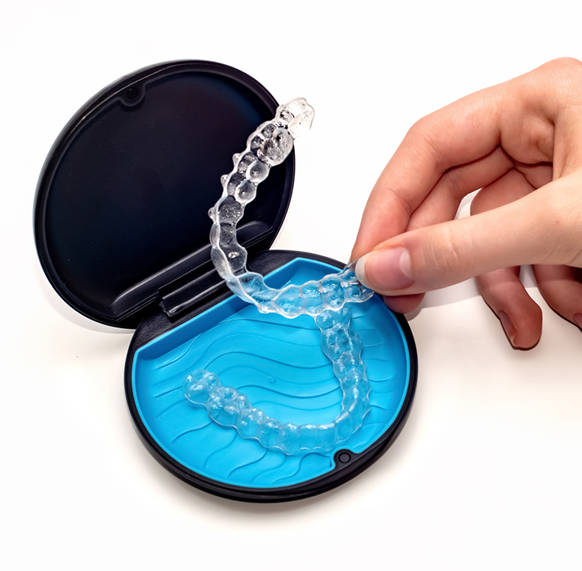
Invisalign has changed the experience of straightening teeth. Instead of brackets and wires, treatment uses a carefully planned series of clear, removable aligners that fit closely over the teeth and guide them into better positions over time.
For many patients, the appeal is practical as well as esthetic. The aligners are discreet, can be removed for meals, and allow patients to brush and floss normally. They can fit comfortably into professional, academic, and social life without drawing unnecessary attention to treatment.
The simplicity of wearing clear aligners, however, should not be confused with simplicity in planning them.
Every tooth movement affects the space around it. The upper and lower teeth must still meet properly. Existing crowns, veneers, implants, worn teeth, missing teeth, and future cosmetic treatment may all influence where the teeth should finish.
At San Diego Integrative & Implant Dentistry, Invisalign treatment is led by a prosthodontist with advanced training in bite relationships, dental implants, crowns, veneers, and complex restorative care. This allows the treatment plan to consider not only how the smile will look, but how the teeth will function within the patient’s complete dental picture.
What Is Invisalign?
Invisalign is a clear aligner system used to move teeth gradually without traditional metal braces.
Treatment begins with a digital scan of the mouth. This creates a detailed three-dimensional model of the teeth, which is used to plan a series of small, controlled movements.
A custom set of aligners is then created. Each aligner moves selected teeth a little farther toward their planned positions. Patients progress through the series according to the schedule provided by their clinician.
The aligners are made from a clear, flexible material and fit closely over the teeth. They are designed to be worn for most of the day and removed for eating, brushing, flossing, and cleaning the aligners.
What Can Invisalign Treat?
Invisalign can be used for a wide range of alignment and bite concerns, from limited cosmetic movement to more involved treatment across both arches.
It may be appropriate for:
The amount of correction possible depends on the position of the teeth and roots, the bite, the available bone, gum health, and the patient’s ability to wear the aligners consistently.
Some patients need a small adjustment to a few visible teeth. Others need coordinated movement throughout the upper and lower arches. The treatment plan is shaped around the actual problem rather than the appearance of the smile alone.
Why Invisalign Treatment Is Led by a Board-Certified Prosthodontist
A prosthodontist is a dental specialist with advanced training in restoring and replacing teeth, managing complex bites, planning dental implants, and designing crowns, veneers, and full-mouth treatment.
This perspective is especially valuable when clear aligner treatment involves more than uncomplicated crowding.
Many adults begin Invisalign treatment with existing dental work. They may already have crowns, veneers, bridges, implants, bonding, missing teeth, or areas of significant wear. Others are considering Invisalign as the first phase of a larger cosmetic or restorative plan.
A prosthodontist considers how tooth movement will affect all of these elements.
For example:
This broader restorative understanding allows Invisalign to become part of a coordinated dental plan rather than a separate cosmetic procedure.
See Your Potential Invisalign Result During the Consultation
One of the most exciting parts of the consultation is the opportunity to see a personalized preview of your potential smile.
We take photographs of your face and smile during the visit. Within minutes, our technology can create a video simulation showing how your own face may look with the proposed tooth alignment.
The preview allows you to see the possible result within your natural features and expressions rather than viewing a generic before-and-after image.
You can consider:
Patients often find that seeing the proposed change makes the conversation more personal. It becomes easier to explain what they like, what they hope to improve, and how they want the finished smile to feel.
The video is a computer-generated preview rather than an exact promise of the final outcome. The clinical treatment plan is developed separately from the examination, digital scan, X-rays, bite assessment, gum health, and condition of the teeth.
What Happens During an Invisalign Consultation?
The consultation begins with a discussion of what you would like to change.
Some patients are most concerned about one crowded area or a space between two teeth. Others want to improve their overall smile or prepare for future restorative treatment.
The evaluation may include:
Current digital X-rays may be brought to the appointment.
Invisalign consultations are complimentary when patients provide suitable current digital X-rays. When new X-rays and complete diagnostic records are required, the consultation and records fee is $199.
The purpose of the consultation is to establish whether Invisalign is suitable, what level of treatment is required, and whether any dental or gum concerns should be addressed before movement begins.
How Invisalign Treatment Is Planned
After the records are completed, the digital scan is used to create a three-dimensional model of the teeth.
The prosthodontist studies:
The initial digital plan can be adjusted by the treating clinician. Tooth positions, timing, attachments, spaces, and bite relationships can be refined before the aligners are ordered.
The technology provides a sophisticated planning tool. The clinical decisions still come from the clinician directing the case.
Attachments, Elastics, and Other Invisalign Features
Some tooth movements require more control than the aligner alone can provide.
Invisalign Attachments
Attachments are small, tooth-colored shapes temporarily bonded to selected teeth. They give the aligners additional grip and help guide movements such as rotation, tipping, or vertical adjustment.
Their number, size, and location depend on the individual treatment plan.
Attachments are removed after active treatment is complete.
Interproximal Reduction
Interproximal reduction involves carefully creating a very small amount of space between selected teeth.
It may be used to:
The enamel reduction is controlled and limited to specific areas identified in the treatment plan.
Buttons and Elastics
Small buttons and orthodontic elastics may be used when the upper and lower teeth need additional guidance.
They can help improve selected bite relationships and support movements that require force between the two arches.
Not every patient needs these features. Their use depends on the complexity of the case.
Wearing Invisalign Aligners
Aligners usually need to be worn for approximately 20 to 22 hours each day, following the schedule provided by the treating clinician.
They are removed for:
Consistent wear is one of the most important parts of treatment. When aligners are left out for long periods, the teeth may not follow the planned sequence and treatment can take longer.
Each new set may feel snug during the first day or two. This pressure is expected and usually becomes less noticeable as the teeth adjust.
The aligners should be cleaned regularly with cool or lukewarm water and the recommended cleaning method. Hot water should be avoided because it can distort the material.
Eating and Daily Life With Invisalign
Because the aligners are removable, there are fewer food restrictions than with traditional braces.
Patients can continue eating most foods after removing the aligners. Before putting them back in, the teeth should be brushed or rinsed and the aligners should be clean.
The removable design also makes routine brushing and flossing more straightforward because there are no fixed brackets or wires to work around.
Patients should still avoid sipping sugary or acidic drinks while wearing the aligners. Liquids can become trapped between the aligner and the tooth surface, increasing the risk of staining or decay.
For most patients, Invisalign becomes a manageable part of daily life once a regular routine is established.
Progress Visits and Refinement Aligners
Patients return periodically so the prosthodontist can evaluate how treatment is progressing.
During these visits, the team may assess:
Some patients require refinement aligners after completing the initial series.
A new scan may be taken, and an additional set of aligners may be created to complete smaller movements or improve the final bite. Refinements are a common part of detailed clear aligner treatment, particularly in moderate and advanced cases.
How Long Does Invisalign Take?
Treatment time depends on the number and type of movements required.
At our practice, Invisalign is organized into three general levels.
Basic Invisalign Treatment
Basic treatment is designed for smaller corrections, including minor crowding, limited spacing, slight rotations, or mild orthodontic relapse.
Treatment is often completed in fewer than nine months.
Moderate Invisalign Treatment
Moderate treatment may involve movement across both arches, several rotated teeth, more noticeable crowding or spacing, and selected bite concerns.
Treatment commonly takes approximately 12 to 18 months.
Advanced Invisalign Treatment
Advanced treatment may involve significant crowding, complex rotations, open bite, deep bite, crossbite, elastics, additional refinements, or coordination with restorative treatment.
These cases often continue for 18 months or longer.
The estimated timeline is reviewed after the diagnostic records and digital treatment plan have been completed.
Invisalign Cost in San Diego
Current Invisalign starting fees at San Diego Integrative & Implant Dentistry are:
The treatment level reflects the complexity of movement, number of aligners, expected treatment time, required attachments or elastics, clinical monitoring, refinements, and restorative planning.
Some dental insurance plans may contribute up to $1,500 toward Invisalign treatment, depending on the patient’s orthodontic benefits.
Flexible payment options may also be available, including:
For qualifying advanced cases, a current treatment benefit may include:
Eligibility and complete terms are reviewed during the consultation.
Invisalign Before Veneers, Crowns, or Dental Implants
Invisalign can sometimes improve the final result of cosmetic or restorative treatment by placing the natural teeth in more favorable positions first.
Before Veneers
Aligning crowded or rotated teeth may allow veneers to be thinner and may reduce the amount of enamel preparation required.
Before Dental Crowns
Tooth movement may create better proportions, improve spacing, or provide more appropriate room for crowns and bridges.
Before Dental Implants
An implant requires adequate space at both the crown level and the root level. Invisalign can position neighboring teeth and roots before implant placement.
Around Existing Implants
A dental implant remains fixed within the bone and cannot be moved orthodontically. Natural teeth can often be moved around it, but the treatment plan must respect the implant’s existing position.
This type of coordination is one of the reasons prosthodontist-led Invisalign care can be particularly helpful for adults with complex dental histories.
Invisalign Versus Traditional Braces
Both Invisalign and traditional braces move teeth through controlled pressure. The main difference is how that pressure is applied.
Invisalign offers:
Traditional braces use fixed brackets and wires. They may be preferable for certain complex movements, patients who do not want responsibility for removable appliances, or cases that require a different form of control.
At our practice, Invisalign pricing is based on treatment complexity rather than being treated as an automatic cosmetic upgrade. For many patients, the financial investment may therefore be comparable with traditional orthodontic treatment.
The best option depends on the movement required and the patient’s lifestyle, preferences, and ability to follow the treatment routine.
Retainers After Invisalign
Once active tooth movement is complete, retainers are used to preserve the new positions.
Teeth can shift throughout life, even after successful orthodontic treatment. Retainer wear helps reduce this movement and protect the time and investment placed into the result.
The prosthodontist will recommend:
Patients should bring their retainers to periodic dental visits so their fit and condition can be evaluated.
Retention is part of the complete Invisalign plan and should be considered from the beginning.
Who Is a Good Candidate for Invisalign?
Invisalign may be appropriate for teenagers and adults who have:
Healthy teeth and gums are important before orthodontic movement begins. Active decay, significant gum inflammation, or untreated periodontal disease may need to be managed first.
Patients who are unlikely to wear removable aligners consistently may receive a more predictable result with fixed braces.
The consultation allows the prosthodontist to determine whether Invisalign, traditional braces, restorative treatment, or a coordinated combination offers the most suitable approach.
Invisalign in San Diego
Invisalign offers a discreet and adaptable way to improve tooth alignment, but the most successful treatment begins with a clear understanding of the bite, the roots, the surrounding tissues, and the patient’s long-term dental plans.
At San Diego Integrative & Implant Dentistry, treatment is led by a board-certified prosthodontist who can coordinate clear aligner therapy with existing crowns, veneers, implants, missing teeth, and future restorative care.
During the consultation, patients can also see a personalized video simulation of their potential result within minutes, making it easier to understand the proposed change and participate in planning the final smile.
Invisalign treatment begins at $2,399 for basic cases, $3,895 for moderate cases, and $5,995 for advanced treatment.
We welcome patients from San Diego, Rancho Bernardo, Poway, Escondido, 4S Ranch, Rancho Santa Fe, and surrounding communities.
Call (858) 779-9292 to arrange an Invisalign consultation.
Frequently Asked Questions About Invisalign
Is Invisalign painful?
Patients usually notice pressure or tightness when beginning a new aligner. This is expected and generally becomes less noticeable within a few days. Significant or persistent pain should be discussed with the treating clinician.
How many hours a day should Invisalign be worn?
Aligners are generally worn for approximately 20 to 22 hours each day. They should be removed for meals, brushing, flossing, and beverages other than plain water.
Can I see what I may look like after Invisalign?
Yes. During the consultation, photographs of your face and smile can be used to create a personalized video simulation within minutes. The preview shows how the proposed tooth alignment may look within your own facial features and expressions.
Can Invisalign correct an overbite or crossbite?
Invisalign can improve selected overbites, deep bites, open bites, and crossbites. Suitability depends on the cause and complexity of the bite concern, as well as the patient’s age and anatomy.
Can I receive Invisalign if I have crowns, veneers, or implants?
Many patients with existing dental work can receive Invisalign. Crowns on natural teeth may move with those teeth, while implants remain fixed in the bone. Treatment must be designed around the location and condition of each restoration.
How much does Invisalign cost?
Basic treatment begins at $2,399, moderate treatment at $3,895, and advanced treatment at $5,995. Insurance may contribute up to $1,500 depending on the patient’s orthodontic benefits.
Is a retainer necessary after Invisalign?
Yes. Teeth can shift after orthodontic treatment, so retainers are used to preserve the new alignment. The recommended schedule depends on the individual patient.